
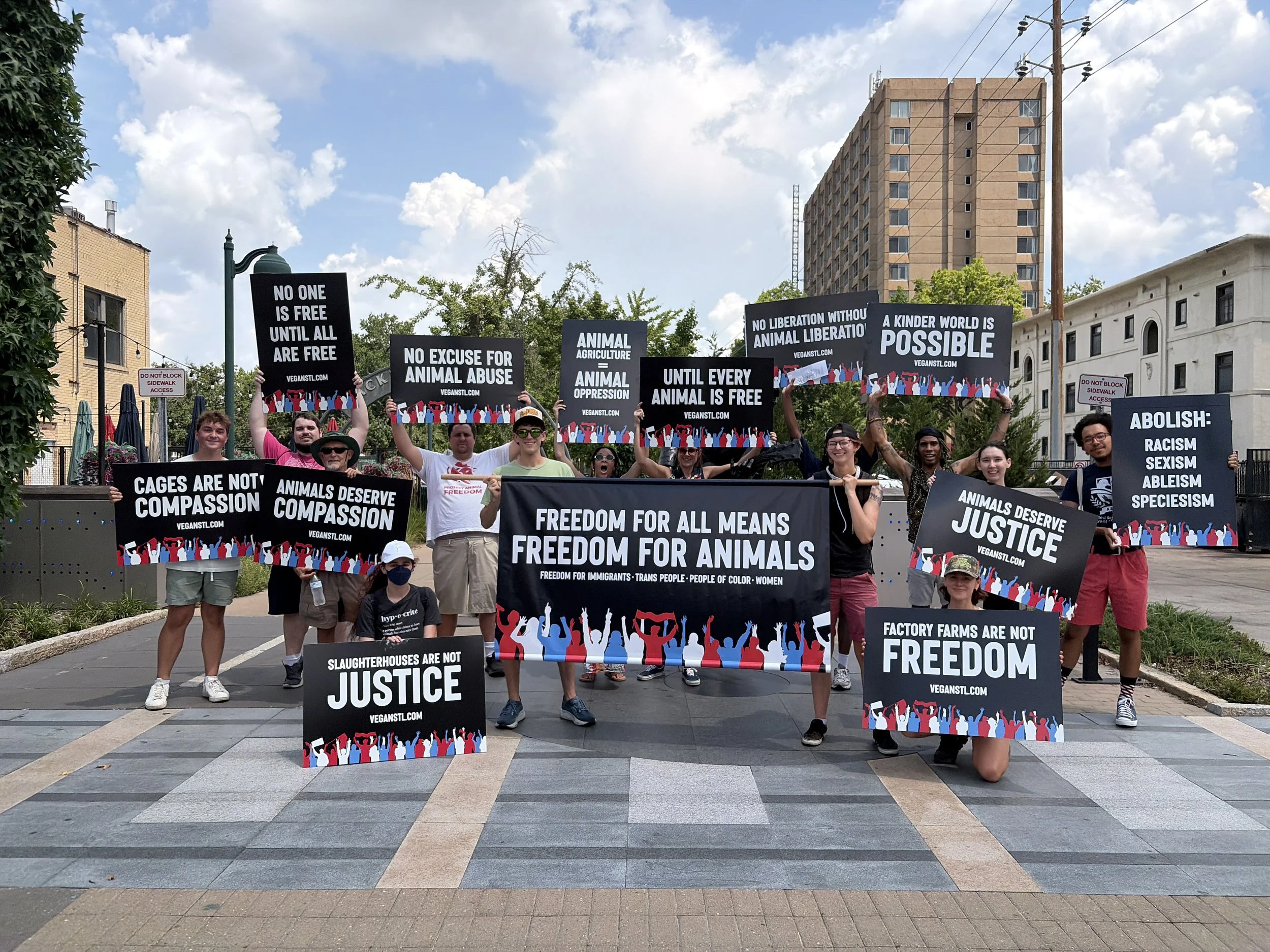
Written by Kyle Luzynski, Founder and Executive Director
Our Theory of Change: Building a Fully Vegan Midwest by 2056
The logic behind the goal: the problems we think have to be solved, the causal chain we are betting on, the evidence behind each step, and the tests that could prove us wrong.
Project Animal Freedom is a St. Louis-based 501(c)(3) nonprofit working to build a fully vegan Midwest by 2056. This page is the logic behind that goal: the problems we think have to be solved, the causal chain we are betting on, the local engine we run in St. Louis, the regional infrastructure we are building around it, the evidence that supports each step, and the tests that could prove us wrong. It is written for anyone deciding whether to invest time, trust, or money in this work, from a first-time volunteer to a foundation program officer.
The short version
- The goal is structural, not personal. A fully vegan Midwest means a region whose institutions, food system, economy, and civic culture no longer depend on the exploitation of animals. It does not mean that every resident of twelve states personally identifies as vegan.
- Four things stand in the way. The industry is strongest exactly where the movement is thinnest. Most people who try vegan living do not sustain it. The movement burns through the people who do the work. And nobody, ourselves included, can currently see the region well enough to fix the first three.
- So we build community first. Creative grassroots vegan community building is our core work: on track for 70+ events in St. Louis in 2026, a monthly vegan market, seasonal challenges designed to help thousands try vegan, and a bench of activists who keep the whole movement running.
- From community, we think the rest follows. Outreach, retention, activists, campaigns, chapters, and a model other cities can copy. We run it as five stages: Reach, Try, Belong, Act, and Multiply.
- The model has to work at three scales. One person moving from stranger to organizer. One city becoming a vegan hub. And one region of twelve states, which will always be larger than our own chapter network.
- That third scale is why we are building a regional layer. A free alliance for organizations that are not ours, a research program that measures the region, a public map, an annual summit, a grantmaking program, a network for vegan markets, and eventually a building.
- Community can help fund the movement too. Every ticketed event we build in St. Louis is packaged so a chapter can host it and keep what it raises. Organizers are not just handed a program. They are handed a way to pay for one.
- We publish two rules and hold ourselves to them. We do not describe an initiative at a stage above the one it has evidence for. And we do not say something is absent when what we mean is that we have not found it.
The evidence is deliberately uneven. Outside research gives meaningful support to Reach, Try, and especially Belong; Act has suggestive evidence but no clean causal ladder; Multiply is still a Project Animal Freedom hypothesis. We show those differences rather than flattening them into one confidence level.
The architecture in one view
The easiest way to read the portfolio is as one local change engine surrounded by regional support systems. The initiatives below are not six separate theories of change; each exists because a specific link in the same chain would otherwise be weak, invisible, underfunded, or trapped inside Project Animal Freedom.
| Layer | Question it answers | What carries it |
|---|---|---|
| Local change engine | How does one person move from exposure to sustained participation? | Reach, Try, Belong, Act, Multiply, run first through St. Louis programs and chapters |
| Regional operating system | How does a twelve-state movement share knowledge and capacity without becoming one organization? | MARA: Measure, Equip, Connect, Sustain. MARI and MARM sit under Measure, MARS under Connect |
| Evidence and accountability | How do we know where gaps are and whether our own model works? | Animal Freedom Lab, MARI, and MARM, with published definitions, methods, limitations, and data governance |
| Capital | How does new local capacity survive long enough to earn its own revenue? | Chapter earned revenue and the Animal Freedom Foundation, formalizing in 2027 with structured grantmaking planned for 2028 |
| Economic infrastructure | How does veganism become ordinary commerce rather than only an advocacy identity? | STL Vegan Market and the Vegan Market Alliance, which is in design and intended to scale recurring vegan-market infrastructure |
| Place | Where can regional work eventually have a durable physical home? | The planned Midwest Animal Rights Center (MARC) |
In shorthand: the five-stage engine tries to create durable local change; MARA helps that capacity travel beyond our own chapters; the Lab and MARI tell us what is true; MARS turns a distributed network into relationships; the Foundation supplies runway; and the Vegan Market Alliance extends the model into the vegan economy.
The problem, in four parts
Most theories of change name one problem. Ours names four, because they are connected, and solving any one of them alone does not get you a region.
1. The industry is strongest where the movement is thinnest
The Midwest is one of the industrial heartlands of American animal agriculture. Midwest states hold the country’s largest concentrations of hogs, egg-laying hens, and turkeys, and their confinement facilities, feedlots, and slaughterhouses shape the lives and deaths of hundreds of millions of animals every year. Several Midwest states have also been central to the history of ag-gag laws restricting undercover investigation of agricultural facilities, from the earliest wave in Kansas and North Dakota to later laws in Iowa and Missouri. Drive an hour in any direction from St. Louis and you pass the industry we are trying to end.
Set against it, by our own inventory, roughly two-thirds of the major metro areas across the Midwest have no local animal rights organization that we have been able to identify. Not an underfunded one. None that we can find. National advocacy campaigns matter, and they cannot substitute for durable local organizing infrastructure. Many of the local groups that do exist run on small volunteer teams with almost no dedicated funding, and whole metro areas lack anyone capable of coordinating volunteers, campaigns, and recurring community programming.
We are deliberate about that phrasing, and it is worth explaining why. Absence of evidence is not evidence of absence. A region-wide claim about what does not exist is exactly the kind of claim that should be made carefully, and “nobody is doing anything there” is a sentence that quietly removes a place from a funding conversation. Replacing our internal inventory with a published, correctable census is one of the reasons for half of what follows on this page. Our current methodology, including how we define the Midwest, what counts as a major metro, and what qualifies as an animal rights organization, is published on our Chapters page.
2. Most people who try vegan living do not sustain it
A landmark 2014 Faunalytics study found that former vegetarians and vegans substantially outnumbered current ones. That study cannot tell us why people lapse, and newer longitudinal research paints a more nuanced picture, identifying barriers that include health concerns, the strength of a person’s vegan identity, perceived social norms, and how much support they get from the people around them. But across that body of research, social support keeps appearing. In the 2014 study, former vegetarians and vegans were nearly twice as likely as current ones to report insufficient interaction with other vegetarians and vegans, at 49% versus 25%.1
We call it the leaky bucket. The movement invests enormous effort in helping people try veganism and comparatively little in what helps people keep it: the local relationships, identities, habits, and support systems that make vegan living easier to sustain. That is not the only thing wrong with the movement. We think it is among the most correctable, and it is rarely treated as a primary intervention, because it does not look like outreach.
3. The movement burns through the people who do the work
There is a second leaking bucket, and it holds organizers.
Faunalytics found that 85% of animal advocates surveyed in the U.S. and Canada had left at least one advocacy role, staying a median of roughly 2.3 years with each organization, with leadership problems named by about 40% and burnout by about 21%. Around 11% had left the animal protection movement altogether. Among unpaid advocates, satisfaction with leadership and identification with fellow advocates stood out as factors linked to staying.2
When a group loses an experienced organizer, it usually loses the relationships, the institutional memory, and the hard-won operational knowledge at the same time. The next cohort starts over. Retention is measurable, and several of the conditions behind it can be changed, which makes this a solvable problem that almost nobody is funded to solve.
4. Nobody can see the region well enough to fix the first three
We have not found a current, public, region-wide source that says which animal rights and vegan advocacy organizations operate in the Midwest, where they are, what they work on, or where none has yet been identified. Advocates here have excellent national and global research available to them. Faunalytics maintains a research library of thousands of studies. Stray Dog Institute runs a global State of the Movement survey tracking how the farmed animal movement allocates resources by region, animal, intervention, and outcome. What is missing is a Midwest-specific operational baseline.
That is an uncomfortable thing for an organization with our stated mission to admit. It is also true, and pretending otherwise would be worse. A movement that cannot describe itself cannot allocate itself well. Without a shared baseline, decisions about where money goes and where the next organizer lands default to impressions, personal networks, and whoever happened to be visible most recently.
Four problems. The rest of this page is four answers.
| The problem | What we build against it |
|---|---|
| The industry is strongest where the movement is thinnest | A chapter network in cities that have none, and a free alliance for the organizations that are not ours |
| Most people who try vegan living do not sustain it | Community, built on purpose, treated as the core of the work rather than the reward for it |
| The movement burns through its people | A standing investment in recruiting, training, and above all sustaining activists for the whole movement |
| Nobody can see the region | A research arm, a regional census, a public map, and a published methodology anyone can check |
What “a fully vegan Midwest” actually means
This is the part of the goal most likely to be misread, so we define it before anything else.
We do not mean that every resident of twelve states will personally identify as vegan. We mean a region whose institutions, food system, economy, and civic culture no longer depend on the exploitation of animals. That distinction matters, because it turns a slogan into four things that can be measured and four things that different bodies of work can aim at.
| What has to change | What it looks like | The work aimed at it |
|---|---|---|
| Civic culture | Vegan community that is ordinary, visible, local, and easy to join in every metro in the region | Events and community circles, chapters, VeganSTL, the Midwest Animal Rights Alliance |
| Food system | Vegan food ubiquitous and increasingly the default rather than the accommodation | The Gateway to Compassion Challenge, the dining guide, restaurant and vendor partnerships |
| Economy | Vegan businesses that can actually make a living, and consumer spending that reaches them | STL Vegan Market, our catering and speaker spending, the Vegan Market Alliance |
| Institutions | Schools, hospitals, governments, and businesses shifting procurement, and the region’s animal agriculture replaced rather than expanded | Pressure campaigns, plant-based institutional work, and a permanent regional center |
Personal diet change is how it starts. Structural change is what finishes it.
The bet: from community, all else follows
Our theory of change rests on one wager, and we state it as a wager rather than a fact: thriving local vegan communities can be the foundation that makes other forms of animal advocacy easier to sustain. Protests need bodies. Campaigns need volunteers. Outreach needs people who stay vegan long enough to bring the next person along. Build the social and practical conditions around vegan living, and you may strengthen the conditions for everything else. Skip them, and even strong outreach can leak people and organizers faster than a movement can replace them.
That is why we call our core work creative grassroots vegan community building, and why we make it unusually central. It is not a warm-up for the real work. It does three jobs at once.
The evidence is strongest in the middle of that wager. Research does not establish that “community” as a generic intervention causes every downstream outcome we want. It does show that social context, identity, perceived norms, and practical support can matter to dietary persistence, and a 2024 preregistered randomized trial gives unusually direct evidence that adding a social component to a meat-reduction challenge can improve persistence after the challenge ends. We use that as support for the mechanism, not as proof that Project Animal Freedom’s events have the same effect.3
Community is outreach
Every public vegan event is a message to the people who are not vegan yet: this is normal, this is joyful, this is possible here. A 100%-vegan BBQ festival tells a St. Louisan something no leaflet can. So does a vegan Halloween party with a chili cook-off, a vegan Thanksgiving feast, a tea party, a karaoke night, a pool party, a book club. Each one says the same thing: you can veganize almost any part of the life you already love.
And the numbers are outreach numbers. A single STL Vegan Market can reach an estimated 50,000 St. Louisans and generate roughly 300,000 views online. A single Vegan Thanksgiving Feast can reach around 20,000 people. Our community events are not a break from outreach. They are some of the most effective outreach we do.
Community is retention
The friend who texts you a recipe. The potluck you do not want to miss. The ride to the march. These are the things that make vegan living easier to sustain when willpower runs out, so we build them on purpose: recurring community circles like The Uncaged Page book club, the Plant Lovers Potluck, and Vegan Game Night; some of St. Louis’ largest online vegan communities; a public Discord; and dozens of events a year where a newcomer can find their people. Belonging cannot guarantee that anyone stays vegan. What it can do is remove one of the barriers the research keeps identifying: trying to sustain a hard change without enough social support.
Community is capacity
Nearly every organizer we have was once a stranger at one of our events. Community is where activists are found. It is also where they are trained and, hardest of all, where they are sustained through the burnout that empties so many groups. The person who came for the ice cream social hands out leaflets that fall, marshals a march the next year, and runs a chapter the year after that. That is the pathway we are deliberately trying to build, and the one we are beginning to measure.
And we do it for the whole movement, not just for ourselves. People we recruit and sustain go on to volunteer at sanctuaries, join national campaigns, and start groups that are not ours. Our organizers are free to volunteer and collaborate with almost any group in their area. We think of this as our meta-community role: a standing investment in the movement’s people that pays out wherever they go.
Recruiting, training, and above all sustaining activists is foundational work that benefits the entire movement, not only the organization doing it. Three things on this page follow from that sentence: an alliance we do not control, toolkits built to be given away, and a research methodology published in full so somebody in a state we will never operate in can run it without us.
The engine: five stages, one loop
Our mission statement names three emphases: grassroots community-building, robust digital outreach, and innovative campaigns. In practice they run as one system with five stages. Each stage feeds the next, and the last feeds the first.
1. Reach: mass-market veganism to the reachable middle
Veganism is a numbers game. We do not spend our energy arguing with the hardest hearts. We mass-market veganism in the marketplace of ideas to the reachable middle: the many thousands of people who would go vegan if it looked normal, local, and doable.
That takes reach, and we have built it. In 2025, our campaigns and communications generated nearly 3.6 million impressions and approximately 860,000 in estimated local reach. In 2026 so far, we have generated over 2 million digital views and website visits, for an estimated local reach of 400,000+ across the St. Louis area. Estimated local reach is adjusted for overlap between channels and is not a deduplicated count of individuals; see “How we would know if we are wrong” below. We have 23,000+ followers across our St. Louis-focused social platforms and 140,000+ across all Project Animal Freedom assets. And VeganSTL.com, our community hub, holds the region’s most comprehensive vegan dining guide, the local events calendar, and a Start Here guide for newcomers.
Reach happens in person too. STL Vegan Market, which we have run since 2024, is our largest recurring vegan event and, by our attendance records, the most attended recurring vegan event we know of in St. Louis: free entry, 20+ vendors, and more than 5,000 aggregate attendees in the 2025 season. Market channels alone accounted for an estimated 730,000 in local reach in 2025.
Why this stage is plausible: veganism is not evaluated in a social vacuum. Qualitative research on anticipated vegan stigma found that non-vegans can avoid plant-based eating partly because they expect social disapproval from family and friends. That does not prove that a festival, website impression, or market visit changes anyone’s diet. It does support the narrower logic of Reach: before people can try something, it helps if the thing looks socially possible, locally available, and less identity-threatening.4
2. Try: seasonal challenges that make the first step easy
Reach is wasted without an easy next step. Ours is the Gateway to Compassion Challenge, our year-round campaign to help St. Louisans try vegan. It runs in three seasons: the St. Louis Veganuary Challenge each January, our independent local challenge inspired by the global campaign; STL VegWeek during Earth Week each April, launching in 2027; and STL VegMonth each November, launching in November 2026.
Each season pairs a free sign-up and local resources with restaurant meetups and four free Thursday Zoom classes: Veganism 101, Vegan Living 101, Vegan STL 101, and Vegan Activism 101. Notice where that ladder ends. In January 2026, 768 people signed up for our first St. Louis Veganuary Challenge. For STL VegMonth 2026 we are aiming for 2,056 sign-ups on a $14,000 budget, which works out to roughly $7 per targeted sign-up: a planning ratio, not a guaranteed acquisition cost.
Why this stage is plausible: challenges themselves have meaningful, though not definitive, support. In Faunalytics’ U.S. research comparing sixteen forms of animal advocacy, people who had encountered meat-free challenges described them as among the tactics most likely to have reduced their animal-product consumption, behind books in the relevant ranking. Faunalytics cautions that these are retrospective self-reports and that people self-select into intensive tactics like challenges. More important for our design, its later challenge synthesis explicitly recommends working with communities rather than only individuals when the goal is lasting change.5
3. Belong: 70+ events a year and a seat at the table
This is the stage we think the movement most underinvests in. We organized 56 events in St. Louis in 2025 and are on track for 70+ in 2026, roughly one every five days. Organization-wide, counting our chapters and our online expos and summits, we are on track for more than 100 events in 2026.
They are deliberately creative, deliberately fun, and deliberately for everyone. Ice cream socials that draw 200+ (our record is 237). A Vegan Halloween Party with a chili cook-off. A Vegan Thanksgiving Feast and a vegan food drive. Vegmas. Trivia night, karaoke, tea, a pool party, block parties, Vegan Pride. Community circles that meet every month. And we spend where it counts: more than $10,000 a year on vegan catering, deliberately with small vegan businesses, and in recent years at least half of it with small Black-owned vegan businesses. We pay our speakers. When we gather, the local vegan economy grows.
Why this stage is plausible: this is the best-supported link in our model, but the evidence is specific rather than magical. In a 2024 preregistered field randomized controlled trial of 1,213 adults in the Netherlands and Flanders, an individual 30-day animal-product-reduction challenge and a social version both reduced consumption during the intervention by roughly 16 to 17% relative to control. Three months later, only the social intervention, in which participants were encouraged to involve family and friends, still showed a statistically significant reduction in animal-product consumption.3 Faunalytics’ six-month longitudinal study of 222 new vegans and vegetarians points in the same direction while adding useful limits: feeling unhealthy, weak veg*n identity, and believing society viewed veg*nism negatively were the strongest measured barriers to maintenance, and social strategies helped people facing low support, negative cultural influence, or very small veg*n networks. But the raw size of a person’s veg*n network, by itself, was not associated with success in that study.6 Our claim is therefore about supportive social context and identity-building, not that more vegan friends automatically means retention.
4. Act: from first bite to front line
Belonging without action is a supper club. So every stage points toward advocacy. Vegan Activism 101 and volunteer orientations teach the basics. Campus leafleting with Vegan Outreach puts “What Is Speciesism?” pamphlets, and Biscoff cookies, in students’ hands every fall; our fall 2026 season opened at Southwestern Illinois College with three activists and 469 pamphlets. Demonstrations, vigils, and marches, including the March to Close All Slaughterhouses and St. Louis’ first Animal Freedom March on July 4, 2026, carry the message into the street. And pressure campaigns, our seventh strategic goal, aim to change institutions, not just individuals.
We also take the movement places it does not usually go. We created the Gay Vegan Expo, the Disabled Vegan Expo, and the Vegan Climate Summit because we saw important intersections the movement was not addressing enough. We host the hard conversations, from Anti-Racism for Vegans to Veganism for Atheists and Veganism for Progressives. And we show up for other movements: Pride parades, climate strikes, women’s marches, housing rallies, the Out of the Darkness suicide prevention walk. Justice for animals belongs inside the larger fight for justice, and we treat it that way.
Why this stage is less certain: the evidence for Act is thinner. A UK survey of 1,000 adults found very low participation in animal activism, but most respondents were not wholly resistant: many had simply never considered activism or said they would like to get involved, with greater willingness for quieter forms such as charity and social activism. That suggests a recruitment opportunity and a need to lower confidence, time, and identity barriers.7 It does not establish that community participation causes activism. A qualitative study of Save Movement vigil participants found no obvious progression from one-time attendee to participant to activist to organizer.8 We should expect multiple pathways, not a conveyor belt.
5. Multiply: chapters, toolkits, and a model built to be copied
Everything above is designed to be repeated in the next city. Through our Compassionate Cities Campaign, we recruit, train, and coach chapter organizers, pairing each one with a chapter coordinator for one-on-one sessions weekly or every other week, backed by organizing guides, event supplies, and funding. Today we have six active chapters across Missouri, Illinois, Nebraska, and Minnesota. Our Decatur, Illinois chapter, named Chapter of the Year in 2024, has operated successfully in a city of about 68,000 people. That is evidence that this work can operate outside a large metropolitan area. It is not evidence that chapter infrastructure caused Decatur’s performance, or that the model will transfer reliably from city to city.
We have also learned to grow at the speed of support. Rather than launch chapters faster than we can back them, we are concentrating on St. Louis as a super-chapter: the place where we build and test the playbooks, then loan them out. Guides for event pages, social media, campaigns, and challenges. A citywide vegan website template, built from VeganSTL.com, that other cities can adopt. Knowledge that belongs to the movement, not to us. We will add two to three chapters by the end of 2026, then keep going.
Why this stage is the least certain of all: in our review, we have not found directly applicable published evidence showing that chapter infrastructure improves durability or outcomes in animal advocacy, or that standardized local playbooks transfer successfully between cities. That is not evidence that they do not work. It means Multiply is a genuine research question rather than a literature-backed conclusion. The Lab should treat organizer retention, recurring-event frequency, supporter growth, and cross-city replication as core tests of this stage.
One thing to notice about these five stages: the system is a loop, not a funnel. The organizers and chapters created at the far end generate the events, campaigns, audiences, and revenue that begin the next cycle. That is what we mean when we say community compounds.
It is also where the model runs out of road, which is the subject of the next section. Multiply, as described here, only multiplies the part of the region we run.
What outside evidence supports, and what it does not
A theory of change becomes more useful when every arrow carries a confidence level. This table is the current evidence map; it should change when better evidence arrives.
| Stage | What outside research supports | What it does not show |
|---|---|---|
| Reach | Anticipated vegan stigma and perceived social norms can inhibit plant-based dietary shifts; normalization is a plausible mechanism for lowering social friction. | That PAF impressions, markets, or events cause diet change, or that more reach is always better reach. |
| Try | Meat-free challenges are among the better-supported intensive advocacy tactics in self-report research, and a randomized 30-day challenge reduced animal-product consumption during the intervention. | That PAF’s Gateway to Compassion Challenge produces the same effect, or that sign-ups equal lasting behavior change. |
| Belong | The strongest evidence in the chain: the social arm of a 2024 randomized challenge retained a consumption effect three months later; longitudinal work finds social strategies useful for several social barriers. | That event attendance itself causes retention. Network size alone was not associated with success in Faunalytics’ longitudinal study. |
| Act | A UK survey suggests substantial latent willingness to participate in animal advocacy and identifies internal barriers that structured, lower-friction opportunities may address. | That community participation causes activism or that people move through a predictable attendee-to-organizer sequence. |
| Multiply | No directly applicable published evidence identified in our review. The logic is testable and PAF has case experience, but the external evidence base is thin. | That chapter affiliation increases durability or that a St. Louis playbook will transfer with the same results elsewhere. |
The middle of the model is where outside evidence gives us the most confidence. The ends are where Project Animal Freedom has the most to prove.
From one city to twelve states
St. Louis could become the best vegan city in America and the Midwest would still be twelve states with an industry in the middle of it. A chapter network, however good, will always be smaller than the region. So there is a second half to this theory of change, and it is mostly about organizations we do not run.
Think of the relationship this way: the five-stage local engine asks how people and cities change. MARA’s four pillars, Measure, Equip, Connect, and Sustain, ask how a region makes that change easier to repeat without forcing independent organizations under one roof. MARI and MARM make the region legible. MARS makes it relational. The Lab makes claims accountable. The Foundation adds capital. The Vegan Market Alliance extends infrastructure into commerce. Each is a response to a bottleneck in the same theory, not a side project.
St. Louis develops. Project Animal Freedom documents. The alliance distributes. Chapters adapt.
That is the operating principle, and everything below is an instrument of it. Local programming in St. Louis is not a distraction from the regional strategy. It is the research and development department for it. A format proves itself here, gets written down, and then travels by whichever route fits: to our own chapters, to organizations that owe us nothing, or to a city we will never set foot in.
The chapter network: the part of the region we run
Chapters operate under our name, with our mentorship, our funding, our systems, and the freedom to innovate locally. Each tends to develop a specialty. Each is meant to become the vegan hub for its city. This is the highest-support, highest-cost, slowest route, and it is the only one where we control the quality directly. It will never cover twelve states on its own, and it was never supposed to.
MARA: the part we do not run
The Midwest Animal Rights Alliance is a free, non-exclusive alliance of animal rights and vegan advocacy organizations across the twelve Midwestern states. There are no dues and no plans to introduce them. Membership turns on what an organization does rather than what kind of organization it is: any group for which advocating an end to animal use and exploitation, or promoting veganism toward that end, is a substantive part of its work belongs in it.
MARA exists to build four shared functions no organization should have to create alone. Measure the movement, so the region can see itself. Equip its organizations, so nobody rebuilds what already exists. Connect its people, so advocates in different states are not strangers. Sustain its capacity, so more organizers have the support to stay involved for the long haul.
Members keep everything: their name, their board, their strategy, their campaigns, and every other affiliation they hold. Every MARA position and joint action is opt-in for each member, individually, every time.
We say the ownership plainly rather than in the fine print. MARA is a project of Project Animal Freedom. It is not an independent organization and it is not on a path to becoming one. We founded it, fund it, staff it, and steward it, and we chair its steering committee permanently while casting one vote like every other member. A structurally independent network is also a structurally capturable one, and keeping stewardship in one accountable place is what lets an alliance hold a direction over a decade rather than a season. What members should hold us to is not our independence but our integrity: criteria published in advance, the same test applied to everyone including us, organizations able to see and contest what is said about them, and an outside reviewer able to check the work.
Why it belongs in a theory of change rather than in a partnerships page: our chapters already get mentorship, tools, funding, and the freedom to innovate. There is no principled reason the group across the state should get less just because their logo is different.
MARI and MARM: how we find out whether any of this is true at regional scale
The Midwest Animal Rights Index is MARA’s research program, conducted through the Animal Freedom Lab. It answers the fourth problem directly. The 2027 baseline edition delivers four things: a systematic census of animal rights and vegan advocacy organizations across the twelve states, a public searchable map (MARM, the Midwest Animal Rights Map), a coverage and gap analysis, and a published methodology with a public-use dataset.
It will deliver no composite score in 2027, whatever the response rate turns out to be, because the right to score has to be earned. The first full State of the Midwest Animal Rights Movement report follows in the next phase, launching at the second MARS Summit in 2028. Where no qualifying organization has been identified in a metro, the map will say “no qualifying organization identified as of [date]” rather than asserting that none exists. That sentence is the whole epistemic standard of this project, and it is the one that costs us most rhetorically, because the careful version of a claim is always the weaker-sounding one.
One functional test governs membership and research alike, so the numbers in one product mean the same thing as the numbers in the next. A gap on the map is not a place that lost. It is a place to invest.
MARS: the weekend the region is in one room
The Midwest Animal Rights Summit is planned as MARA’s annual in-person gathering, and it is where the alliance stops being a mailing list and becomes a room full of people. The inaugural summit is planned for late September or early October 2027, venue to be confirmed, with the exact weekend scheduled to be announced at our Vegan Trivia Night on October 19, 2026. MARI’s first findings are presented there; full MARI 2027 publication follows in October with the methodology, public-use dataset, and no composite score. The first full State of the Midwest Animal Rights Movement report launches at MARS II in 2028 and, from then on, MARS is its annual release point.
The third problem is why this event exists at all. Identification with fellow advocates is one of the factors linked to staying in this movement, and it is not something you can send someone by email.
The Animal Freedom Lab: the instrument panel
The Animal Freedom Lab is our research arm, launching in January 2027. It runs MARI. It curates research that already exists and puts it where an organizer will actually meet it, inside toolkits, training, and mentorship, with citations attached. And it holds the definitions that make our own claims checkable, applying them to Project Animal Freedom before anyone else.
It is deliberately small at launch. It is not running a program of original studies in 2027; the first hypothesis-driven study, on what sustains new vegans, is planned for 2029 with contracted research leadership or an academic partner. It is not an academic institute and nothing goes through journal peer review. What it goes through instead is preregistration before fieldwork, published methodology, independent methodological review, and a public-use dataset. And it is not independent of us, which is a real conflict of interest we name rather than manage quietly, because we are one of the organizations MARI counts.
The reason a small nonprofit has a research arm at all is in the next-to-last section of this page. A compounding model that is right gets stronger every cycle. A compounding model that is wrong also gets stronger every cycle, and from the inside the two look identical.
The Animal Freedom Foundation: the money that moves outward
The Animal Freedom Foundation is our grantmaking program. It is not a separate legal entity, has no separate board or EIN, and holds no endowment; a gift to it is a designated gift to Project Animal Freedom. We are naming it while it is small on purpose, because the discipline of grantmaking is easier to build when the sums are in the thousands than to improvise later when they are in the hundreds of thousands. It is being formalized in 2027, and structured grantmaking begins in 2028.
It is built out of two things we already do. We invest in chapters from central funds, so an organizer in a new city does not start from zero. And we give money to groups that are not ours: in 2025 we directed roughly 3% of our revenue to other organizations fighting for people, animals, and the planet. What neither has yet is criteria published in advance, an application anyone can see, a written record of why one request was funded and another was not, or a report at the end saying what the money did. The Foundation is the name for fixing that.
One boundary is worth stating here rather than burying on a funding page: measurement does not decide funding. We run the region’s research program and we will eventually assess organizations through it. The organization holding the tape measure should not also decide who gets paid on the strength of it, so a MARI assessment will not function as an eligibility screen for a Foundation grant, in either direction. We are writing that rule down now, while we are the only ones in the room.
The Vegan Market Alliance: the economy
Project Animal Freedom is building the Vegan Market Alliance: an initiative designed to become a network for the people who organize recurring, fully vegan markets, and a deliberate effort to help more of those markets start, improve, and last. Its purpose is to build the humane economy where animals no longer suffer and die for profit by connecting, growing, and maximizing the impact of vegan markets.
It is in design and incubation as of September 2026, not an operating alliance. There is no member network, no published playbook, no market census, and no governing body yet. What exists is the operating experience: STL Vegan Market, which we have run since 2024.
Two things make it belong here rather than in a list of side projects. It aims squarely at the economy line of the destination, which no other part of our portfolio does. And it is a version of Multiply that can travel without a chapter: a market can be replicated by an organizer who will never join anything of ours, which means it can reach further than our chapter footprint ever will.
MARC: the address
The Midwest Animal Rights Center is a planned physical center in or around St. Louis, targeted for 2028, intended to serve as Project Animal Freedom’s headquarters and a permanent regional node for the movement. It is the one thing on this page that cannot be replicated by publishing a document, and that is the point of it.
MARA organizes the movement. MARI measures it. MARM maps it. MARS brings it together. The Lab holds the standards behind the measuring, the Foundation builds the capital layer, and the Vegan Market Alliance extends the model into commerce.
Where each piece of our work sits in the theory
This is the whole portfolio in one table: what each thing is, which part of the theory it serves, and how far along it actually is. The last column is the important one, and the next section explains why.
| The work | What it is | Where it sits | Stage now |
|---|---|---|---|
| St. Louis events and community circles | 70+ events a year, from book club to BBQ fest | Belong, and the laboratory for everything else | Running |
| VeganSTL.com | Citywide vegan hub: dining guide, events, Start Here | Reach, and the template for other cities | Running |
| Gateway to Compassion Challenge | Veganuary, VegWeek, and VegMonth seasons | Try | Running; VegWeek launches 2027 |
| STL Vegan Market | Free monthly all-vegan market since 2024 | Reach, and the economy | Running |
| Chapter network and Compassionate Cities | Six chapters, one-to-one organizer mentorship | Multiply, inside our own name | Running |
| Ticketed event packages | Formats a chapter can host and fund itself from | Multiply, and the money layer | Being documented |
| Midwest Animal Rights Alliance (MARA) | Free regional alliance of independent organizations | Multiply, beyond our own chapters | Founding, 2027 |
| MARI and MARM | Regional census, map, and gap analysis | The evidence layer under the whole model | Baseline edition 2027 |
| MARS Summit | Planned annual gathering of the alliance | Sustain, and where the research is presented | Inaugural summit 2027 |
| Animal Freedom Lab | Our research arm and our measurement standards | Tests the model and holds us to our own claims | Opens January 2027 |
| Animal Freedom Foundation | Our grantmaking program | The money layer, moving outward | Formalizing 2027 |
| Vegan Market Alliance | Network being built for recurring vegan markets | Reach and the economy, at a scale beyond us | In design |
| Midwest Animal Rights Center (MARC) | Planned physical center and headquarters | A permanent regional home for the work | Planned 2028 |
Two rules we publish so you can hold us to them
A page that names an alliance, an index, a map, a summit, a lab, a foundation, a market network, and a building can read like a catalogue of things that do not exist. So we hold ourselves to a rule, adopted as policy rather than as a sentiment.
No initiative may be described publicly at a stage above the one it has evidence for.
That is why the table above ends in a stage column, why most of the regional layer says 2027 rather than “now,” and why the Vegan Market Alliance is described as being built rather than as a network. An initiative belongs to the year it becomes consequential, not the year it is announced.
The second rule is the epistemic one, and it applies to every claim we make about places rather than about ourselves.
Absence of evidence is not evidence of absence. Where no qualifying organization has been identified, we say so, rather than asserting that none exists.
It costs us. The careful version of a claim is always the weaker-sounding version, and “two-thirds of Midwest metros have nobody” is a better fundraising sentence than the one we actually use. We would rather be right than persuasive, and the census exists to replace the careful sentence with a documented one.
One more thing follows from those rules. We do not use a single definition of success for everything we build. A building succeeds by being open and used. A census succeeds by being cited, repeated, and relied on. A service succeeds when somebody outside the organization can operate it from documentation alone. A format succeeds when other people run their own versions. An idea succeeds when it turns up in other people’s language without our name attached. Asking whether anyone has reproduced a building without our staff is the wrong test of the building.
The money layer: building financial infrastructure for the movement
A theory of change that ignores money is not a theory of change. Many local animal rights groups operate with very limited resources, and those that rely on a small number of institutional funders are exposed when priorities change. When a single funder moves on, programs can shrink overnight. We have watched it happen to good organizations doing good work. So we build the other thing, and it has two halves.
The first half: earned revenue chapters keep
Every ticketed event we run in St. Louis is designed from the start to be run by any chapter. A vegan Thanksgiving feast. A trivia night with tiered tickets and a silent auction of donated goods from local businesses. A holiday dinner, an awards ceremony, a chili cook-off. We build each one once, then package the whole thing: the format, the pricing tiers, the venue checklist, the sponsor and in-kind donation letters, the ticketing setup, the promo pipeline, the run of show. A chapter organizer in another city does not have to invent a fundraiser. They pick one off the shelf, host it, and the money it raises funds their chapter’s work.
Behind all of it is one shared database. Project Animal Freedom runs the entire organization, and every chapter within it, on a single centralized system rather than a patchwork of personal spreadsheets and free mailing-list accounts. Supporters are tied to their chapter, so we can send targeted emails, texts, and fundraising appeals to the people in a given city rather than blasting everyone. A new organizer in a new metro inherits real infrastructure on day one: a way to collect sign-ups, track supporters, sell tickets, take donations, and ask their own local list for money.
The compounding effect is the point. An organizer who has run one ticketed event has done real fundraising: set a price, asked local businesses for donations, filled a room, thanked the donors, and closed the books. Those skills go a long way toward deciding whether a local group still exists in five years, and we think fundraising is a capacity the movement should teach far more deliberately. That is why our chapter mentorship works on money directly, and why we intend to track central subsidy, locally raised revenue, and percentage self-funded for each chapter as the model matures.
The second half: grants that cover the runway
Earned revenue is the destination. Very few chapters arrive there in year one. Grants are the runway that gets an organizer from the first meeting to the first fundraiser, and they are what keeps a good chapter alive through a bad quarter. A movement that only funds groups already capable of funding themselves is not building anything new.
That is the Animal Freedom Foundation’s job. Roughly $5,000 in direct seed funding supports a chapter’s first year of local programming; the fully allocated cost, once central staff time, technology, insurance, and mentorship are counted, is closer to $18,000. Those are two different numbers measuring two different things, and we try to say which one we mean every time. Over time the Foundation is also the vehicle for grants to organizations that are not ours, which is where the 3% becomes a budgeted, criteria-driven, reported line rather than a decision made once a year by one person.
And how we spend the rest
The same logic governs our spending. More than $10,000 a year on vegan catering goes deliberately to small vegan businesses, and we pay our speakers rather than asking them to donate their expertise. We keep as much of our event spending as practical inside the vegan economy. Our own funding is built the way we teach it: more than 2,000 small grassroots donors rather than one or two institutional lifelines.
For a funder, this is the difference between buying a year of programming and buying durable capacity. A grant that helps us package a ticketed event creates a reusable fundraising asset that can generate revenue repeatedly across every chapter that adopts it.
Why St. Louis, and why the Midwest
St. Louis is home. It is our oldest, largest, and most active chapter, our base of operations, and the proving ground for everything we do. In 2021 we narrowed our mission from a fully vegan world by 2056 to a fully vegan Midwest by 2056, because focus wins. The Midwest is one of the regions where animal agriculture is strongest and local advocacy thinnest, and where a win would matter most. Success here would strengthen the case that thriving vegan movements can be built far beyond the places where veganism is already culturally established.
The longer version of this argument, written for donors and funders, is on Why Fund Animal Rights in the Midwest?
What makes this approach different
- Community first. Community is usually treated as the reward for activism. We reverse the sequence and treat it as the engine.
- Movement first. We exist for the animals, not for a brand. We recruit and sustain activists for the whole movement, partner with organizations like PETA and Vegan Outreach, publish our methodology so other regions can copy it, and in 2025 directed roughly 3% of our revenue to other groups fighting for people, animals, and the planet. A fair share of what we build is meant to be used by people who will never write us a thank-you note.
- Financially empowering. We aim to give chapters more than a program: the infrastructure to run it and a way to pay for it. Every ticketed event we build in St. Louis is packaged so a chapter can host it, promote it to its own segment of one shared supporter database, and keep building real revenue.
- Measured, and willing to be wrong. We are building a research arm specifically to test our own model, including the parts that would embarrass us. The methodology publishes in full, the study is preregistered before fieldwork, coverage and response rate lead the reporting rather than sitting in a footnote, and we are assessed against the same criteria as everyone else.
- Careful in public. Two published rules, stated above, that constrain what we are allowed to claim. Most organizations our size do not put a limit on their own marketing in writing.
- Creative and unafraid. Gay Vegan Expo. Disabled Vegan Expo. A worldwide Vegan Climate March. Veganism for Atheists. If nobody has tried it, that is an argument for trying it.
- Lean and volunteer-powered. On track for more than 100 events and over 2 million views in 2026. In 2025 we delivered this work with $112,597 in total expenses, funded largely by a grassroots base of more than 2,000 individual donors. Our founder has never drawn a salary. That is a point of pride and a limit: to last, this work needs durable paid staffing, and we are building toward it.
How we would know if we are wrong
A theory of change is a set of expectations about cause and effect. Ours now has an evidence shape we can state plainly: the middle is stronger than the ends. Try and especially Belong have meaningful outside support. Reach has a plausible social-norm mechanism. Act has suggestive participation evidence. Multiply is largely unproven. None of that outside research tests Project Animal Freedom as a whole.
What we have directly observed is narrower: our own outputs and immediate results, meaning attendance, challenge sign-ups, reach, volunteer pathways, chapter activity, repeat events, and revenue. Those observations matter, but they do not become causal evidence because they appear in a theory-of-change diagram. We do not yet know how much of a participant’s later diet, activism, or organizing can be attributed to us.
So the page uses four evidence categories without pretending they are interchangeable: outside research supports a mechanism; Project Animal Freedom has observed an output or pathway; the Lab is testing an association; or the claim remains a hypothesis. Where people choose their own level of involvement, association is the ceiling unless a stronger design earns the right to say more.
| The hypothesis | Evidence status now | How it gets checked |
|---|---|---|
| Community improves retention | Outside evidence supports the mechanism; PAF-specific effect unproven. | Compare retention among challenge participants with higher versus lower community participation, reported as an association because participants select their own involvement. |
| Community creates activists | Suggestive participation evidence; no demonstrated PAF causal pathway. | Track what share of event and community participants later volunteer, organize, or lead. A share, not an anecdote about one organizer. |
| Chapter infrastructure increases durability | No directly applicable published animal-advocacy evidence identified in our review. | Organizer retention, recurring-event frequency, supporter growth, and continuity after leadership transitions, chapter by chapter. |
| St. Louis playbooks transfer | No directly applicable published evidence identified; this is a replication hypothesis. | Compare outcomes in chapters that adopt packaged programs with those that adapt or improvise locally, documenting context and which components appear load-bearing. |
Where the evidence is thinner than we would like
Reach is supported mainly at the mechanism level: stigma and perceived norms can deter change, but we do not have evidence that our particular form of mass-market normalization overcomes them. Act is a plausible opportunity, not a proven ladder: people may be open to lower-friction forms of advocacy, while qualitative evidence warns against assuming that participation naturally escalates into organizing.
Belong needs precision too. The longitudinal Faunalytics study did not find that simply knowing more vegans or vegetarians predicted success. What appeared useful were social strategies for people facing social barriers. That is why our measurement question is not “did you acquire more vegan friends?” but whether supportive participation, identity, practical help, and repeated community engagement are associated with sustained change.
Multiply is the largest gap. We have case experience, documentation, mentorship, and a theory of why shared infrastructure should reduce restart costs. We do not yet have outside evidence that chapter infrastructure makes animal-advocacy organizations more durable or that a playbook built in St. Louis transfers cleanly to another city. If that stage fails, the regional strategy has to change rather than the evidence standard.
Why this needs a research arm and not just a spreadsheet
Our model is a loop rather than a funnel, and loops compound. A compounding model that is right gets stronger every cycle. A compounding model that is wrong also gets stronger every cycle, and from the inside the two look exactly the same. Measurement is how an organization finds out which one it is running while there is still time to change it.
That is also why the research sits with the Animal Freedom Lab rather than with whoever writes the fundraising copy. A finding that contradicts our model is the single most valuable thing the Lab can produce, because it is the only thing that can stop us spending a decade being confidently wrong.
We define our terms
Most of what damages movement research is not fraud. It is loose language. So four different things get four different words, and the Lab applies them to Project Animal Freedom before anyone else.
- Views and impressions are gross exposures.
- Platform reach is a platform’s own unique-account count.
- Estimated local reach is our cross-channel estimate, which can contain duplication.
- People reached is reserved for deduplicated counts we can document.
Two more distinctions do the same work. Outputs are not outcomes: a march happening is an output, a law changing is an outcome, and we will not blur them. And association is not attribution: where people choose their own level of involvement, we report relationships as associations unless a research design supports more.
What we track, and what starts next
We track leading indicators: events per year, attendance, challenge sign-ups, mailing-list growth (8,500 subscribers, including 2,600+ active local subscribers, as of August 2026), followers, active volunteers, and chapters. And we are building outcome measures. Beginning with STL VegMonth 2026, challenge participants tell us how they eat when they sign up and again one month and four months later, so we can report how many stayed vegan or kept reducing, with the response rate printed next to the result rather than underneath it. When the Lab opens in January 2027 it inherits that instrument, the follow-up, and the honesty of the reporting. We publish what we find in our impact reports.
We do not claim to know how many people we have made vegan. We will tell you how many we helped try, how many came back, how many stayed, and how many now organize.
That is the trail from an ice cream social to an empty cage.
What would make us change the model
The model rests on assumptions we intend to keep testing: that people open to veganism can be reached efficiently; that challenges can convert attention into a first sustained attempt; that supportive local belonging improves the odds of persistence; that some share of participants become advocates and organizers; that chapter infrastructure improves durability; and that playbooks developed in St. Louis transfer to other Midwestern cities with enough local adaptation. If challenge participants who engage deeply with community do no better over time, if volunteer conversion does not rise with repeated participation, if supported chapters are no more durable than comparable independent groups, or if playbooks repeatedly fail outside St. Louis, those are not communications problems. They are evidence against the model.
An organization that will not test its own thesis is not running a strategy. It is defending a preference.
The four-year arc
Almost everything in the regional layer above can be announced in the first months of 2027. None of it becomes consequential that fast. So the portfolio runs on a four-year framework, the Animal Freedom Renaissance, with a fundraising campaign underneath it called the Midwestern Moonshot. Each year describes what Project Animal Freedom is to the outside world, and each initiative gets its own developmental assignment inside it.
| Year and phase | What it means |
|---|---|
| 2027 Institution | Project Animal Freedom becomes an employer, with real finances, real governance, and a leadership plan that does not rest on one person. MARA, the Animal Freedom Lab, MARI’s baseline census and map, and the first MARS Summit launch. |
| 2028 Infrastructure | We build what other groups use: the Midwest Animal Rights Center, the first full State of the Midwest Animal Rights Movement report, a replicable citywide website, a toolkit library, and revenue models chapters can run themselves. |
| 2029 Inspiration | The model gets tested outside the Midwest. Our first original research begins. A successor starts shadowing the Executive Director role. |
| 2030 Ideology | The ideas are given somewhere to live beyond the organization: an ethics institute, a mature solidarity movement, an endowment, and a new Executive Director. |
The annual headline describes the organization’s condition, not every initiative inside it. We can be building infrastructure in 2028 while half the portfolio is still establishing itself, and saying so is the point of having stage gates at all.
What’s next
2026 and 2027 are the biggest years in our history.
- STL VegMonth, November 2026. The most ambitious campaign we have ever run: a $14,000 budget, 10+ events, sponsored local media, and a goal of 2,056 challenge sign-ups. It is also where our first retention follow-up survey begins.
- St. Louis Veganuary, January 2027, and STL VegWeek, April 2027. Our second local Veganuary and our first Earth Week campaign.
- Two to three new chapters by the end of 2026, plus new community circles in St. Louis.
- The Animal Freedom Lab opens, January 2027, and MARI fieldwork runs March to May across twelve states.
- MARA’s founding cohort, and the first MARS Summit in late September or early October 2027.
- A paid team. Our next hires, as funding allows: fundraising and donor engagement, social media, events, market management, and web. See open roles.
- Toolkits and a template. Publishing our playbooks, packaging our ticketed events so chapters can use them as local fundraisers, and building a replicable citywide vegan hub so the next city starts where we are, not where we started.
What your support does
We run on volunteer leadership, so a gift goes a long way. Here is what it funds.
- About $7 is what we budget per challenge sign-up in the Gateway to Compassion Challenge.
- $5,000 is direct seed funding for one chapter for a year. The fully allocated cost, including central staff time, technology, and mentorship, is closer to $18,000.
- $14,000 runs STL VegMonth 2026 from start to finish.
- And there is one gift that changes what anyone in this region can know. MARI’s coverage is bought with fieldwork hours: somebody has to find every organization across twelve states, send the invitation, send it again, and then pick up the phone. Funding the fieldwork does not make the report prettier. It makes more of the Midwest visible in it.
For foundations and major donors: we are building a model the movement can copy, in the region that needs it most, with a deliberately lean cost structure. We would welcome a conversation. Write to info@projectanimalfreedom.org or call 314-740-0436.
Donate to the Animal Freedom Fund Join our mailing list Volunteer
You can also start a chapter or join the alliance.
From community, all else follows. Until every animal is free.
Frequently asked questions
What is Project Animal Freedom’s theory of change?
Build thriving local vegan communities first, because community can function as outreach, as support for retention, and as capacity all at once. Combine that community with robust digital outreach and innovative campaigns, develop and test the model in St. Louis, then move what works outward by three routes: our own chapters, a free regional alliance of organizations we do not run, and published toolkits and methodology anyone can use.
What do you mean by a “fully vegan Midwest”?
Not that every resident of twelve states will personally identify as vegan. We mean a region whose institutions, food system, economy, and civic culture no longer depend on the exploitation of animals: thriving vegan communities and local animal rights organizations throughout the region; vegan food that is ubiquitous and increasingly the default; schools, hospitals, governments, and businesses shifting their procurement; and the region’s animal agriculture replaced rather than expanded. Personal diet change is how it starts. Structural change is what finishes it.
Why 2056?
It is not a scientific forecast. It is an organizing deadline: long enough to build institutions across an entire region, short enough to impose urgency and accountability on the people leading the organization today. A deadline does something a vague aspiration cannot. It forces us to ask, every year, whether we are on pace.
Is community building just socializing?
A potluck is socializing. A potluck designed to put vegan food in front of a curious coworker, to give newer vegans the social support that research links to sustaining the change, and to surface the volunteer who might run next spring’s march is infrastructure. The difference is intent and follow-through, and we design every event with the next step built in.
Why is a small nonprofit launching this many new initiatives at once?
Because most of them are one strategy with different names. The alliance, the index, the map, the summit, the lab, the foundation, and the market network all exist to move what we have proven in one city out to a region we will never fully staff. And they are sequenced rather than simultaneous: the four-year arc above gives each of them years to become consequential, and our own policy forbids describing any of them as further along than the evidence supports.
Is the Midwest Animal Rights Alliance a separate organization from Project Animal Freedom?
No. MARA is a project of Project Animal Freedom, permanently. We founded it, fund it, staff it, and steward it, and we chair its steering committee while casting one vote like every other member. It cannot be separated from us by a vote of its members. Member organizations, by contrast, are fully independent: they keep their name, their board, their strategy, their campaigns, and every other affiliation, and every alliance position is opt-in.
Do you rank other organizations?
Eventually, internally, yes, because a serious audit of a regional movement means assessing the organizations in it. What gets published is deliberately narrow: an annual Top Ten voted by the alliance, which an organization can decline to be named in. Nothing below it is published, an organization’s own assessment goes to it rather than to the public, criteria are published before the period they govern, and Project Animal Freedom is assessed on the same criteria and takes no part in voting on its own placement. None of it exists yet. The scored index is the last thing the research program builds.
Does the research arm make you a research organization?
No. The Animal Freedom Lab is small and has a narrow remit: run the regional census, curate research that already exists so organizers can use it, and hold the definitions that make our own claims checkable. It is not running a program of original studies in 2027, and nothing it publishes goes through journal peer review. What it goes through instead is preregistration, published methodology, independent methodological review, and a public-use dataset.
Do chapters raise their own money?
Yes, and we treat it as core to the model rather than a nice-to-have. Every ticketed event we run in St. Louis is packaged so a chapter can host its own version and raise money from it, and chapter coordinators work with organizers on fundraising weekly or every other week. We also invest in chapters from our global funds while they build that capacity, which is the practice the Animal Freedom Foundation is being built out of.
Is the Vegan Market Alliance a network I can join?
Not yet. It is in design. If you run a recurring vegan market anywhere, or want to start one, we would like to hear from you now, while the founding work is still being shaped. We will not call it a network before it is one.
Is Project Animal Freedom a national organization?
We are a Midwest-focused organization headquartered in St. Louis, with chapters in Missouri, Illinois, Nebraska, and Minnesota, and online expos, summits, and webinars that reach people around the world. We narrowed our mission from the world to the Midwest in 2021, on purpose. Our toolkits, templates, and published research are free to anyone anywhere.
How is Project Animal Freedom funded?
Primarily by a grassroots base of more than 2,000 individual donors, alongside grants, sponsorships, and event revenue. Our founder and Executive Director serves without a salary, and we intend to expand our paid team as funding allows. Project Animal Freedom is a registered 501(c)(3) nonprofit, EIN 83-3007847, so donations are tax-deductible to the extent the law allows.
How does Project Animal Freedom measure impact?
With defined metrics (views, platform reach, estimated local reach, and documented people reached are four different things), leading indicators like events, attendance, sign-ups, and mailing-list growth, and, beginning with STL VegMonth 2026, follow-up surveys that track whether challenge participants stay vegan. Our impact reports are public.
Can my city use this model?
Apply to launch a chapter and we will pair you with a coordinator. If you already run an animal rights or vegan group in the Midwest, join the alliance instead, free, and keep everything about your organization exactly as it is. And if you are outside the region entirely, the toolkits, templates, and methodology will be free to you too. A Great Plains version of this, or a Southern one, would be a success of this project rather than competition with it.
Sources and notes
These sources do different jobs. Some support a mechanism in the theory; some describe the animal-advocacy movement; some document the Midwest context; and some are Project Animal Freedom’s own operating records. None tests this organization’s full model end to end. That distinction is why the Animal Freedom Lab exists.
Diet change, challenges, and retention
- 1. Faunalytics, 2014. Study of Current and Former Vegetarians and Vegans. Used for the former/current comparison and the 49% versus 25% “insufficient interaction” result. Cross-sectional and retrospective; not causal.
- 3. Severijns et al., 2024. “Involving family and friends helps sustainable diets last longer,” npj Climate Action 3:109. Preregistered field randomized controlled trial, n=1,213; both individual and social 30-day challenges reduced animal-product consumption during the intervention, while only the social arm retained a statistically significant reduction three months later.
- 5. Faunalytics, 2022 and 2025. Planting Seeds: The Impact of Diet & Different Animal Advocacy Tactics and Tactics in Practice: The Science of Vegan Challenges. Used for the relative placement of meat-free challenges among sixteen advocacy tactics, the self-report and self-selection caveats, and the recommendation to work with communities rather than only individuals.
- 6. Anderson & Milyavskaya / Faunalytics, 2022. Going Vegan or Vegetarian: Barriers and Strategies on the Path to Success. Six-month longitudinal study of 222 new vegans and vegetarians. Used for the health, identity, social-perception, support-strategy, and network-size findings. Network size itself was not associated with success; social strategies were helpful for several social barriers.
Social identity, norms, and vegan stigma
- 4. Markowski & Roxburgh, 2019. “If I became a vegan, my family and friends would hate me”: Anticipating vegan stigma as a barrier to plant-based diets, Appetite 135:1–9, doi:10.1016/j.appet.2018.12.040. Qualitative focus-group evidence that anticipated stigma can inhibit plant-based dietary shifts.
Activism, organizer retention, and participation
- 2. Faunalytics, 2020. The State of Animal Advocacy in the U.S. & Canada: Experiences & Turnover. Used for 85% having left at least one role, the 2.3-year median tenure, leadership and burnout reasons, and the movement-exit figure.
- 7. Bryant Research, Quiet Activism. Survey and report based on 1,000 UK adults. Used only as suggestive evidence that many non-participants are not categorically opposed to animal advocacy and may prefer lower-friction forms. It does not test Project Animal Freedom’s volunteer pathway.
- 8. Faunalytics, 2016. A Study of the Motivations and Barriers to Participation in the Save Movement. Twenty-four semi-structured interviews; used as a caution against assuming a simple attendee-to-organizer progression.
Movement measurement and regional infrastructure
- Existing movement research. Faunalytics maintains a large animal-advocacy research library; Stray Dog Institute runs State of the Movement work on resource allocation. We use these rather than duplicate them. What we have not identified is a current public Midwest-specific operational baseline covering qualifying organizations across all twelve states.
- The coverage claim. “Roughly two-thirds of the major metro areas across the Midwest have no local animal rights organization that we have been able to identify” is Project Animal Freedom’s current internal inventory, not a published census. The methodology is published on the Chapters page, and MARI 2027 is designed to replace the inventory with a published, correctable baseline.
- Multiply evidence gap. We have not identified directly applicable published animal-advocacy evidence that chapter infrastructure improves organizational durability or that standardized local playbooks transfer outcomes across cities. Under our epistemic rule, that remains a research gap, not a claim that no such evidence exists.
Midwest animal agriculture and policy environment
- Midwest animal agriculture. USDA National Agricultural Statistics Service Census of Agriculture and livestock and poultry summaries are the basis for the state-level concentration claims about hogs, egg-laying hens, and turkeys. This is not a claim that the Midwest leads in total farmed animals; broiler chickens numerically dominate U.S. land-animal production and are concentrated in the South.
- Ag-gag history. Ceryes, C. A. & Heaney, C. D. (2019), “Ag-Gag” Laws: Evolution, Resurgence, and Public Health Implications, New Solutions, plus the Animal Legal Defense Fund’s current tracker, for the history of state restrictions discussed here.
Project Animal Freedom program, financial, and reach data
- Reach and engagement. Figures come from Meta Business Suite and Squarespace analytics. 2026 figures are year to date. Estimated local reach is adjusted for cross-channel overlap and may still contain duplication; it is not a deduplicated people count.
- Organizational history and program records. Our impact page and internal event, chapter, challenge, attendance, and donor records support the history and operating figures used on this page.
- Financial scale and status. ProPublica Nonprofit Explorer carries the organization’s IRS filings. The 2025 figures used here are $113,875 in revenue and $112,597 in expenses.
- Program outcomes and methods. Retention follow-up methodology for STL VegMonth publishes with the first results in 2027. MARI’s methodology, definitions, eligibility criteria, sampling, limitations, and version history publish ahead of 2027 fieldwork.
The bottom line on evidence: outside research gives us priors, mechanisms, and warnings. It does not tell us that Project Animal Freedom works. The Animal Freedom Lab exists to close exactly that gap, and to publish the answer even if the answer is inconvenient.
Written by Kyle Luzynski, Founder and Executive Director. Last updated September 2026.
Project Animal Freedom is an IRS-recognized 501(c)(3) nonprofit, EIN 83-3007847.
Spot something wrong on this page? Email info@projectanimalfreedom.org and we will correct it.